

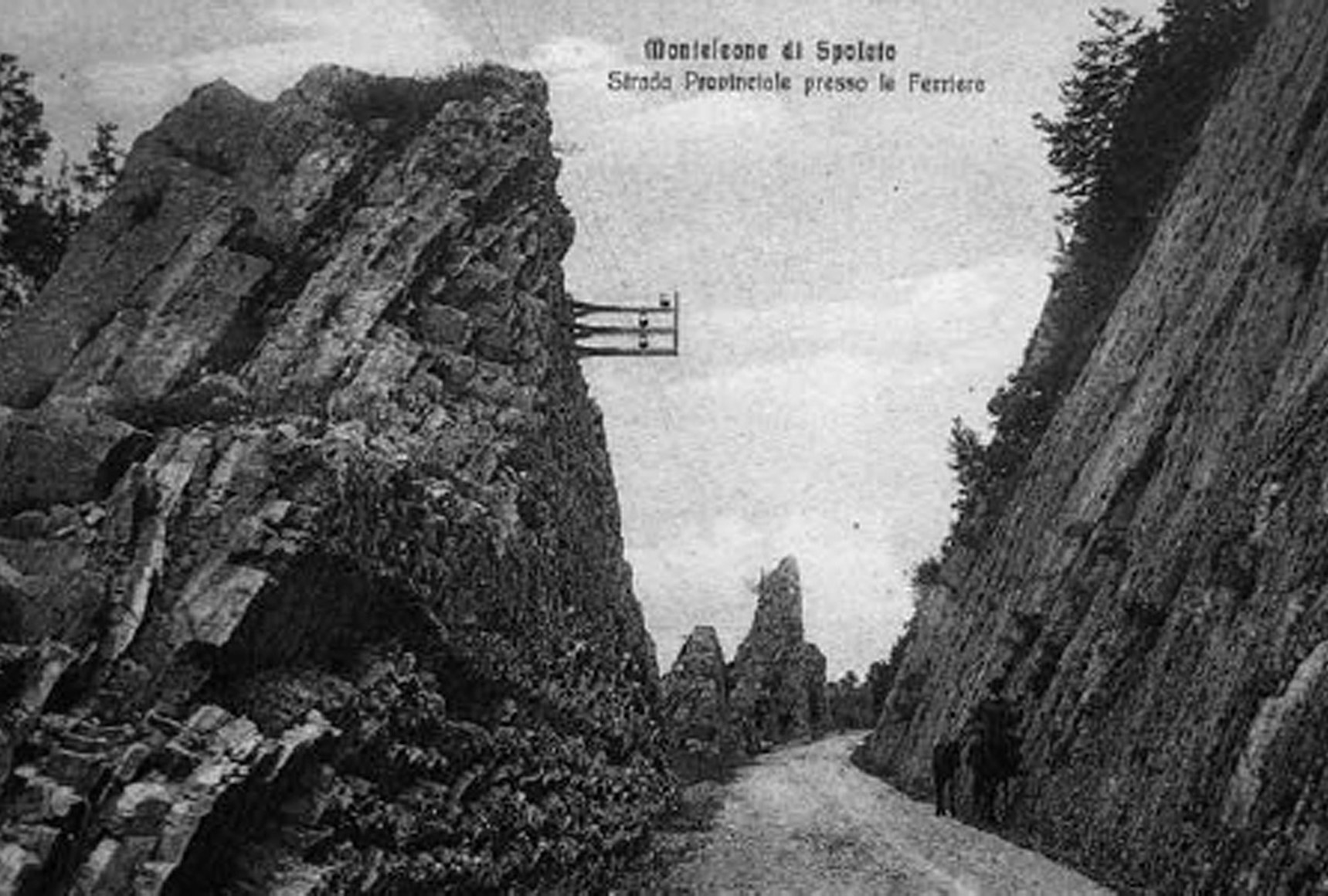
Description
The production is interrupted by the earthquake of 1703, which deflects the course of the Corno River (there is still today the "Bridge of the ironworks"). The next attempt of recovery is a failure. The ironworks of Monteleone of Spoleto are one of the first proto-industrial activities in the Papal States, the precursors of the development of Terni. In 1631 the State buys a mill on the Corno River to build an oven. To improve links between mining areas and those of final processing, Urbano VIII in 1634 realizes the construction of the road from the Flaminia through Monteleone, where it crosses the Corno River on a bridge called "Ironworks" even today. The activity starts in 1634 under the State management of the Apostolic Camera; from 1645 is leased to Pio and Benedetto Matascioli of Norcia and in 1692 to the Tuscan Marquis Girolamo Albergotti. The disastrous earthquake of 1703 diverts irreparably the course of the river water, which is essential for the industrial processing. After a long inactivity, there is a brief attempt to recovery ending in 1798, always due to hydraulic problems.
The Ironworks of Monteleone, once called "the iron factory", are an integral and significant part of the mining and metallurgical national history, ranking over more than two centuries. They are one of the first proto-industrial production activities in the Papal States and the precursors of the later development of Terni area. Their development and the short life of the blast furnace enterprise for the exploitation of iron in the territory of Monteleone di Spoleto during the last decade of the eighteenth century, is only a part of the long history of mining research. Already in 1580 there are news, in the deliberations of meetings of the Courts of Terni (the so called "Riformanze"), about the request and concession to Buzzoleni (from Bozzolo Castle of Mantua), of a license for the use of an "iron and copper ironwork" for a period of 40 years. Yet in 1629 a new mine is discovered in Cascia Mountain, "slightest than other mines, it can be particularly useful for corselets, morions and muskets". A few years later, there are news about Monteleone and its own territory. It is in fact in 1631 that the State, and thus the public power, takes the initiative to buy a mill on the course of the Corno River to build an oven. Specialists, experts in the matter and two known surveyors, Mario Gentili and Domenico Castelli are sent to the mountains around the village to check out the ground and have an exact report to be submitted to the authority of the Apostolic Camera. The mining and metallurgy activities are generally contracted out to individuals with long-term contracts, which provide for privileges for the management and the marketing of products, while maintaining the State control. To
improve links between mining areas and those of the final processing, Urbano VIII in 1634 implements an important road work, with the construction of a road from the Flaminia, through the location Palazzo del Papa in Strettura leads to Ferentillo in Valnerina, through Case, Gavelli and Monteleone, continuing to Cascia and Norcia through the Corno River passing through a bridge still today called "Ironworks Brisge (Ponte delle Ferriere)". The inscription of Strettura, now lost, is the following one: "VRBANVS VIII.PONT.MAX. / VIAM HANC FODINARVM VSVI / ET PVBLICAE / COMODITATI APERVIT ET STRAVIT / AC MONTEM LEONEM CASSIAM / ET NVRSIAM PROTENDIT / ANNO SALVTIS MDCXXXIV. PONT. XII. " The
activity of the Monteleone oven begins in 1634 under direct state management of the Apostolic Camera up to 1644. Among the various delegates it is must be remembered also the Roman (but of local origin) Giulio Sinibaldi. In 1637 the new and near Terrargo mine opens, contracted to Domenico Gervasoni from Como (the descendants are still present in Monteleone). The hematite is extracted in Monteleone mines, which is a soft, malleable and high-quality material. This material is toasted in a large inverted cone ovens, alternating layers of wood and mineral to facilitate the separation of the earth and the subsequent waste. When the process is finished, it is washed and introduced into real ovens, whose power is generated by the fall of water from the nearby Corno river. In Scheggino there is another ironworks, which receives iron from the oven of Monteleone to convert into quality iron. The importance that Pope Urbano VIII assigns to the exploitation of mineral resources is also evidenced by the commemorative medal minted in 1642, which reports on one side the bust of the Pope and on the other a metallurgical furnace with busy miners in strip mine at the background and the word "FERRI FODINIS APERTIS ROMA MDCXXXXII" (a copy of it is jealously preserved in the Municipality of Monteleone di Spoleto until the mid-twentieth century). From June 4th, 1645 the ironworks is leased to Pio and Benedetto Matascioli, brothers of Norcia, and they continue until the year 1692, when the Tuscan Marquis Girolamo Albergotti succeeds them, who runs the business since the devastating earthquake of January 1703, which irreparably diverts the river and its waters, which are essential to provide the mechanical energy needed to move hammers and equipment for blowing air into the furnace, causing the collapse of the water divider and serious damages to the oven and the structures. The previous year, Piersanti foresaw the end of the ironworks, writing: "the Ironworks are deteriorating more and more, which were made with profusion of so much money and care." In 1777, but more concretely in 1788, the interest to resume business after more than 80 years of stopping is renewed by the R.C.A., opening or expanding the mines in Gavelli, in Salto, in Terrago, Comuvole and Rescia. The company stops in 1798, in the period of the Roman Republic, always due to hydraulic nature difficulties of the same course of water.