

Description
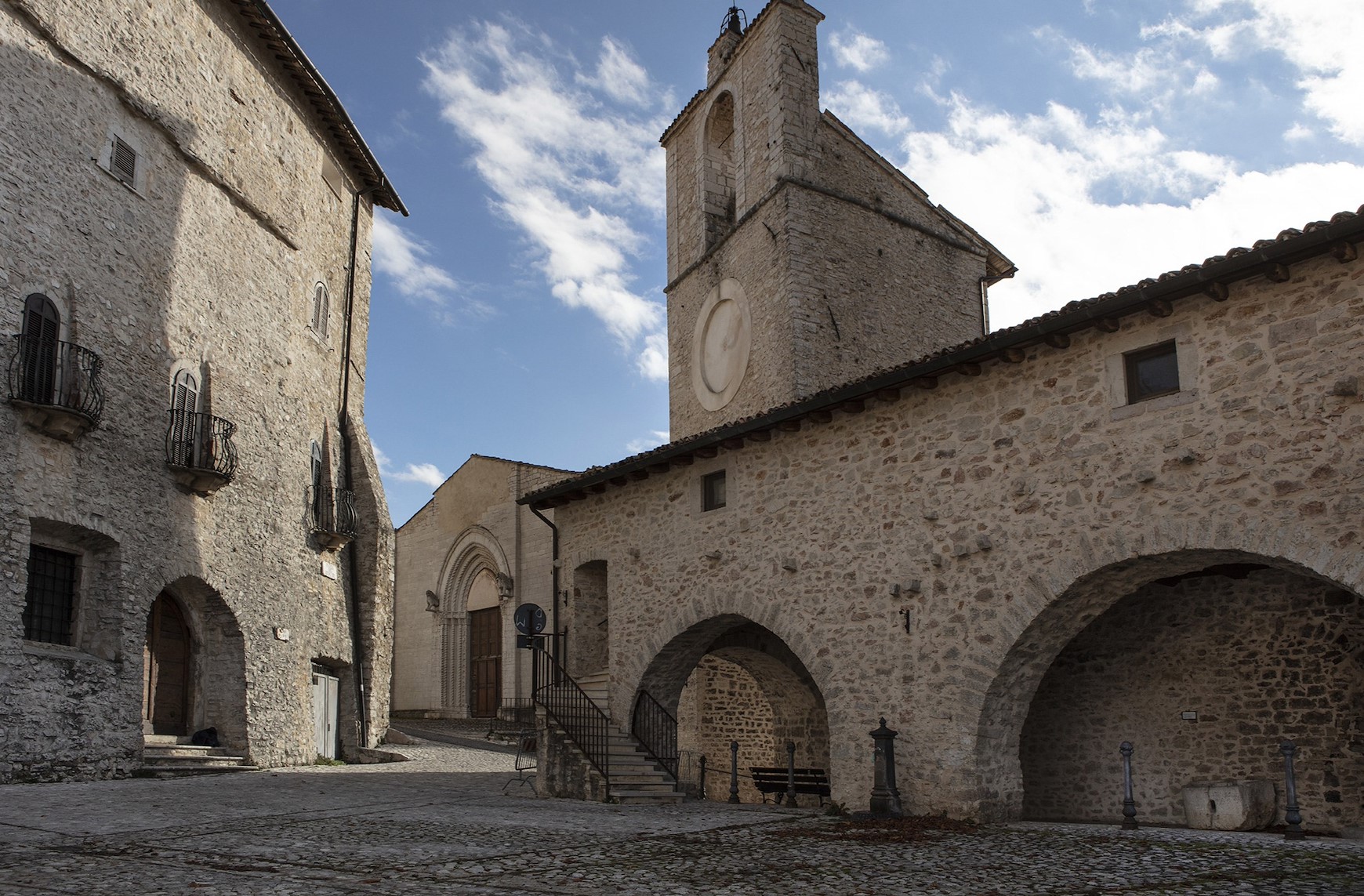
Through the entrance of the picturesque clock tower (one of the three gates of the second wall) of the second half of the thirteenth century, one can enter the oldest part of the village, which is characterized by a maze of alleys, according to a typical Medieval urban layout, and has its epicenter in the Tiberti castle, now disappeared. Near the Civic Tower that dominates the Renaissance village below, there is a lovely little square, better known as the Market Square. Its origin must date back to the late sixteenth century with the gradual transfer of the administrative and social life from the ancient feudal manor to the area occupied by the church of St. Maria near Priori Palace (today part of the Municipal Theatre). With the death of Paul IV and with the election of Giovanni Angelo Medici of Marignano, the future Pio IV (25 December 1559), a golden age begins for Monteleone with a strong recovery in construction and by the release of long- standing issues that undermined the peace and trade. With this pontificate, the disputes between Cascia and Monteleone, that damage to property and animals, finally stop; Cascia is forced to repair the damage, and both sides are forced to sign the peace agreement. The passage under the Legation of Perugia, and hegemony subtraction of Spoleto is welcomed with great joy and gratitude to the new pope by the inhabitants of Monteleone and by the Municipality. With this event the previous coat of arms, represented by a rampant lion holding a bunch of ears of wheat (symbol of prosperity, but perhaps even an atavistic memory of the ancient agrarian cult of the Goddess Cybele) is replaced by a new figuration with a rampant lion on five mountains that holds two keys. Thereby the keys, present in the coat of arms, can be read in an ambivalent and reciprocal way, either as an offer to the castle, or the full subjugation of the town to St. Peter and therefore to the Pope, to whom the inhabitants are recognized as protected children. Pio IV, in fact, to avoid the continuous border disputes, has submitted Monteleone to the Legation of Perugia and the inhabitants, gathered in a public assembly, must accept. Since then, thanks to the favorable position of control on the border between the Papal State and Kingdom of Naples, the center becomes the site of a major permanent military garrison. From that moment a particularly happy time begins for Monteleone; the city life is reorganized, the defenses of the castle and of the town are strengthened with walls and ramparts stretching for over 1500 meters, best example of military architecture of the time, worthy of a great city. Even the market, already erected in the time of Pope Paul III, a vital center of public life, increases with the creation of a special square next to the clock tower and a portico covered where the ancient agrarian measures in stone, guaranteed by the state, are lined (such as “il quarto”, “la mezzenga”, “lo scorzo”). This particular stone, still present under the loggia, allows accurate measurement of solids avoiding any fraud made by patrons or rogue traders. The tower, considered the ancient gateway to the original urban center, becomes soon the community symbol. Originally there was a small bell tower for the Municipal bell for public gatherings. Later on it is replaced by a sundial, and then by a mechanical clock. On the external front, below the watch there is a historical memory linked to the Italian Renaissance. The text, composed by Mr. Angelo Tortoreto Catignano (PE), has the following inscription:
WATCHFUL SENTINEL OF THE APPENINE/ IN THE STRUGGLES FOR THE LIBERATION/ MONTELEONE STOOD IN FIRST POSITION/ COMPANION CITIES OF SLAVERY/
SAW THEIR CHILDREN GOING/
TO GLORIFY THE VICTORIES OF GARIBALDI/ TO BOOST THE REVOLT/
WHEN FROM UMBRIA/
THE COLORS OF ITALY WERE FORBIDDEN/ ON THIS TOWER THE REDEEMER/ CHALLENGED THE TREATNING TYRANT/ PRISONS, EXILES, LOOTINGS, FIRES/
- /
DURING THE FIFTTHIES ANNIVERSARY OF THE LIBERATION/ MUNICIPALITY AND PEOPLE /
PROF. TORTORETO ANGELO - II OCTOBER MCMX.
The text is the implicit reference to Pio IX (called "Tyrant") and to the advancing Sardinia-Piedmont troops on earth Umbra. In fact, Vittorio Emanuele II, afraid of the advancing reign of Naples with its Pro Dictator Garibaldi and of the risk that he would declare the Republic, orders in September 1860 the invasion of the Papal States. On 11th September of the same year, the first Piedmonts troops cross the borders between the Marches and Umbria. Four days later an Extraordinary General Commissioner is established for the Pontifical Province of Umbria. On 17th of that month Spoleto is taken and occupied, while in all the lands now occupied (but not yet officially unified) are introduced the new legal stamps of Sardinia State. On 2nd October also Monteleone falls (or it is "Liberated") and on 5th October the new rates of the Savoiardo State are spread throughout the province. Umbria and its centers officially become part of the new Kingdom of Italy following a Plebiscite held between 5th and 6th November 1860. For historical correctness, it must be admitted that, even though it is decanted from the Renaissance historiography, this event and other plebiscites organized in several stages during the unification are not so "democratic" according to the contemporary meaning of the term and are not held by an universal suffrage, in fact women, poor people, illiterate ones, and all those Italian imprisoned, who fought on the front to defend the legitimate national states, are excluded. The important history of that inscription is clear, however, because it is a forerunner of the Unification of Italy, because the entry and the "liberation" date of Monteleone di Spoleto occur with the first Piedmonts troops on 5th October 1860, five months before the official date day and Italian National Unity Day.
Image gallery


