

Description
The village of Monteleone is full of esoteric suggestions, not only for the palpable presence of the spirits of the mountains, but also for the mysterious presences who breath in the old walls of the village. Monteleone, with its stone, tells us about its ancient castle of Brufa, the imposing city walls (the second made in Templar era -1265-), the bulwark of the Knights of St. John, the Renaissance village with its rich palaces, the symbols and the writings carved in the convents and church portals, which were a refuge for the pilgrims, merchants and warriors. Historical investigation can find important means of interpretation by the analysis and the reading of these symbols that come up to us by the wisdom of the ancients.
The sacred science of symbols
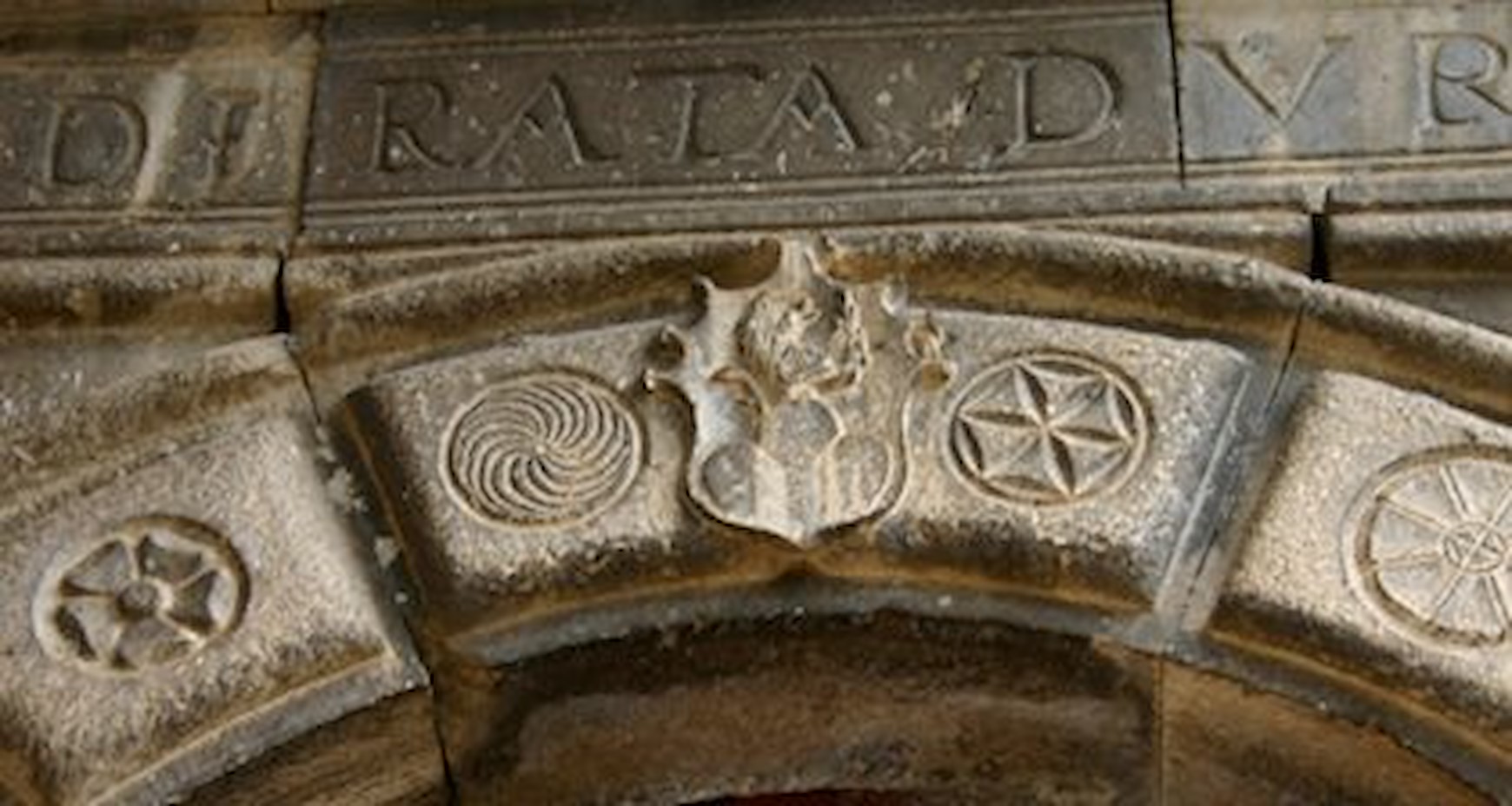
Among the various forms of communication, the indirect language of symbols is expressively richer, but even more ambiguous: it must be therefore considered not for what it is by itself, but for the ability to represent another thing connected to its specific context of time, place and group. The symbols of Monteleone tell us precisely the sacredness of this place, making us think of ancient mysteries hidden within its triple walls. It is certainly curious the recurrence of certain numbers: there are three city walls and each with three ports, six towers and eight bastions of the city! Stars with six or eight tips are found in various friezes and frescoes.
The symbolism of numbers in Monteleone:
3 - The town walls and doors represent the completion of Creation. The Man, son of Heaven and Earth (CHRIST - the Son of God who becomes man) 6 - The Towers and the stars of some frescoes and friezes depicted also as a star of David or as a Seal of Solomon, are the symbolic image of the duality (heaven and earth, tall and low ect.), mediation between Principle and Manifestation (Christ is a mediator for the salvation of the man) 8 - The ramparts and the stars of some frescoes and friezes are the mediation between the Earth (square) and Heaven (circle), they are the symbols of the transfiguration and announce the way of the Righteous and the Resurrection. These first references lead us to consider symbolic the city of Monteleone di Spoleto as a holy city, likely custodian of a mystery tied to Christ, also confirmed by the presence in Monteleone of Spoleto Crocigeri orders (bearers of the cross- Crusaders) as those of St. John and St. James.
The Order of the Warrior Monks of Monteleone: the Hospital of the Star
In Monteleone, near San Giacomo gate, there was the convent of Hospitallers Cruciferi (bearers of the cross
- Crusaders) who, in addition to control the precious spring of Coppo, they ran the Hospital of the Star, a detachment Hospital of the Star of Spoleto. Many authors report that the order of St. James derives directly from the Templars, who have, among other duties, to protect the springs and it is therefore conceivable that the hospital of San Giacomo of Monteleone may have been, in the twelfth century, a Templar mansion. This hypothesis overlooks the mystery linked to an inscription placed on the lintel of a portal, dated around the seventeenth century., which shows the motto of the Order of the Templar Knights: NON NOBIS DNE SED YOUR NOMINI TUO (DA GLORIAM), in other words: Not for my glory but for your glory, oh Lord. Although the lintel presents a later date, it is not inconceivable that in the reconstruction phase, subsequent to catastrophic earthquake of 1703, someone (perhaps a brotherhood) wanted to bring this ancient motto to witness the Templar tradition of this city.
The symbol of the Star and the sacred feminine
It is of no small suggestion the name assigned to the building of the order of St. James: '' Hospital of the Star ''. Many hospitals operated in the Middle Ages by “crocigeri” monks have this name, with a strong reference to Mary Magdalene as a result of the worship of the sacred feminine and of the Holy Grail. The same Templar symbol of the eight-pointed star is a strong appeal to the sacred feminine. The Grail, In fact, is the symbolic image of the great mother, of the divine lineage, of the lost goddess. A star with eight bits is the symbol of the Order of the Temple, it is meant to represent the balance of the cosmos; it recalls also the image of the ROSE OF THE WINDS and the RAYS OF A WHEEL. This symbol represents the mediation between the Earth (square) and Heaven (circle) and the transfiguration and it announces the way of the Righteous and Resurrection. The star, the rose (the white rose of the Divine Comedy: '' ... the Saints were shown to me in the shape of a White Rose, which in her blood Christ made her bride ...) and the wheel are symbolic images of Virgin and the emblems of the secret Templar (Militia Christi). They represent the best
center (Stella Polar) and a source of light useful to overcome the earthly suffering and to have spiritual and material salvation. Striking symbolic images lead us to think of the Hospital of the Star of Monteleone as a place of salvation, a safe haven where the pilgrims can alleviate their suffering, but also as a temple of the Templar Mystery of the Graal. The Wheel and the Stars are reproduced in some coats of arms and in some of the palaces portals of Monteleone di Spoleto, while there is still visible a Templar cross on the lintel of a portal of a chapel adjoining to a noble palace.
The Chapter Hall of the Convent of San Francesco
The references to the sacred feminine, to the Grail, to the Seal of Solomon, force us to dwell on the fresco of St. Catherine of Alexandria placed in the Chapter House of the Convent of San Francesco. Aside from the charm of the entire structure, frescoed with sacred images, there are some symbolic references: the six- pointed stars of the barrel vault, but especially the role of Santa Caterina, enriched with images of the Star of David or the Seal of Solomon alternated with those of a square inscribed in two circles crosses. The image of Santa Caterina of the convent of San Francesco does not respect her classic iconography which usually represents her with a crown, the symbol of her kingship, with the toothed wheel and the sword, instruments of her martyrdom, with the palm, the symbol of the victory over evil, and sometimes even with a book that reminds her culture. This fresco, with the exception of the wheel on the right side of Santa Caterina, has no other iconographic references, but presents strong symbolic features on the vest of Santa Caterina belonging to the Grail legend and to the hidden secret of Solomon Temple. In particular, the square inscribed in two circles evokes precisely the symbolism of the rose and the wheel and therefore of the number eight: the union between earth (square) and the sky (circle) or the resurrection and transfiguration, but also the Templar secret of the sacred feminine. The colors used in the fresco are special: black, red and white are the Templar colors (black or white cloak and red cross) and are the colors of the alchemical symbolism, in particular of the phases that characterize the realization of the ''Great Work ''.
The Bastion of San Giovanni
The Knights of San Giovanni or of Rhodes run several hospitals and, as the Templars, are warrior monks engaged on the roads of the Holy Land to the defense and care of the pilgrims. The presence of these knights in Monteleone is clear from the name of a bastion placed at the entrance of the city, but especially from some marks left in the stone. The bastion of St. John is in fact a defensive bulwark probably manned by the same monks, in fact in the adjacent church façade there are still a few coats of arms attributed to this Order. It could be also that the Bastion of San Giovanni is passed into Johannite hands in the early fourteenth century, as inheritance derived by the suppression of the Templars…
The coat of arms of the church of San Giovanni
In the Johannite buildings are often found marble coats of arms in relief depicting those of the Big Masters of the Order and the Weapon of the Order. These typical examples can be seen on the island of Rhodes. In facade of the church of San Giovanni of Monteleone are still some coats of arms that recall strongly to those found in Rhodes. The presence of these coats of arms leads to the assumption that the Johannite garrison of Monteleone di Spoleto is quite important, not excluding the establishment of a commandry or a castle.
Suggestive hypotheses
The reading of the symbolic language leads us to consider the city of Monteleone di Spoleto as a sacred place, inviolable temple of ancient mysteries transmitted from generation to generation in secret esoteric
rituals. Certainly during the Middle Ages in Monteleone there is the presence of the monastic-military and of the cross-bearers orders, including the Hospitallers and perhaps even the Templars, not excluding the presence of the subsequent direct initiatory organizations which are heirs of the Templar Secret (Patio Secreta, Jacobiti, brotherhoods, Rosicrucian academies atc.). it is very easy to assume that the trade of relics from the Holy Land, particularly widespread in time of the Crusades, has resulted in the town of Monteleone di Spoleto some rare findings (maybe linked precisely to Saint Catherine of Alexandria), then hidden in the secret monasteries of the Cross.